Tuesday, August 06, 2013

Charging The Mound, For Beginners

AUGUST 6th, 2013-I'm not a guy who really cares for this sort of thing. But if you gotta throw down, throw down. And after hearing of Legends LF Terrance Gore's beaning at the hands of Asheville Tourists righty Rayan Gonzalez a few hours ago, I was 'inspired', shall we say, to broach the subject of bench-clearing brawls. (Note: Gore was the first batter Gonzalez has hit, this year, but he beaned him. And hard, too). I don't want to focus on that particular incident, though it got me a little hot under the collar to hear that T was potentially badly hurt (he's not, as far as I know).

Ty Cobb once said that baseball "is something like a war". Zack Greinke thinks he's dead right.

Greinke made the mistake of targeting Padres OF Carlos Quentin earlier in the year for something like the 15th time in his career, and Quentin decided to audition for the Chargers while he had the chance. Why, exactly, Greinke has such a need to drill the Padres linebacker/occasionally healthy outfielder, I have no idea. But lo and behold, on April 11th of this year the slightly-built Dodgers righty thought he'd send a message to the unfortunate batter, and that message was "I'm dying for a beat-down".


Quentin was happy to oblige.

As you can see in the above video, Greinke has a poor grasp of basic tackling skills (and physics), as he only slightly lowers his shoulder into the charging rhino that is Quentin. He got mildly stomped for his trouble, and suffered a broken collarbone to boot.

My personal feeling on this fight is that it never should have happened. Problem is, Quentin has been plunked by Greinke so often that I suppose he got the idea that Greinke had some sort of vendetta. It used to be that 'misunderstandings' like this were settled on the field; one pitcher would hit a batter (whether accidentally or intentionally), the opposing pitcher would respond in kind. End of story.

But it seems nowadays that most players can't just let it go at that. Some will even get bent out of shape when a pitcher has the GALL to pitch on the inner part of the plate. How dare they! As if that part of the plate even belongs to the pitcher!

What a steaming load of horsecrap. So many sensitive hitters out there. Makes me wonder if modern players have a full understanding of the game. But I digress.

Brawls have been a part of the game for as long as it has been played, at every level. One of the more famous was the Nolan Ryan-Robin Ventura bout back in 1993, in which Ryan instructed the young Mr. Ventura in the finer art of noogies:


In this instance, Ryan had 21 years on the 25 year-old Ventura, and it's believed (citation needed) that his love tap of a fastball to the White Sox third sacker's spine was merely his way of telling him that he had neglected to buy a ticket for the Ryan Express. Ventura was kind enough to offer the demi-god pitcher the top of his skull as payment for the ride. And had his fine motor skills beaten out of him, because of it.

Ah, the olden days. Hey, kids! Remember black and white TV? Course, you don't.


The date was July 22nd, 1986. The SF Giants were lost in the Busch, facing off against the Cardinals. RHP Frank Williams was the pitcher, OF Vince Coleman the batter. Williams was in the middle of what would be an outstanding season, posting a scintillating 1.20 ERA over 52 1/3 IP for the Giants. Of note is the 4 batters he hit, on the year. Four. Indeed, over his career he hit only 20 batsmen in 471 2/3 innings. Mr. Coleman would be one of the twenty.

As you see in the video, Williams had already come up and in (way up, way in) to the left-handed batting Coleman, and manager Roger Craig took some exception to this. As it turns out, so did Coleman.

On the very next pitch, Ol' Frank nailed him. Benches cleared, anger simmered, blah blah blah...

Next thing you know, C Mike Heath literally has to carry Vince off the field. This is just after Heath had to subdue him by wrestling him to the ground. So Vince was perhaps a little miffed by the whole experience.

Other highlights of this bout: IF Joel Youngblood in what appears to be a reversed sleeper hold, Cards skipper Whitey Herzog shoulder-blocked by Giants IF Randy Kutcher, and #43 of the Giants (who I can only assume is a coach) entertaining thoughts of causing mayhem in the stands. This one had it all.

Rewind even further to August 12th, 1984, Padres @ Braves. San Diego was on their way to a 92-70 finish, a narrow victory over the Chicago Cubs in the NLCS, and a 5-game elimination in the World Series which came courtesy of the Detroit Tigers. Atlanta, on the other hand, was fighting for its place in the annals of mediocrity; however, though they would finish tied for 2nd in the NL West with the Houston Astros, their record was a less-than-compelling 80-82, good for 12 games out of first place. So San Diego was the only team in their division to finish with a winning record in 1984. Baseball is a funny game.

Anyhew, the game starts off on the right (wrong?) foot, with human Jheri Curl and RHP Pascual Perez went right after the lefty-batting 2B Alan Wiggins, who would steal 70 bags that year and 242 in 631 ML games before his life was cut tragically short in 1991 at the age of 32. That, however, is another story.


Not a team willing to forgive and forget, the Pads waited all the way until the bottom of the 8th, when LHP Craig Lefferts decided to express his disapproval with the offender himself, laying a love tap on the right-handed batter Perez.

When I think about it, I can't remember the last time I saw a pitcher actually get plunked in retaliation. Hm.

That should have been the end of it, right? Wrong, again. Enter RHP Donnie Moore (another tragic story) in the top of the 9th. Moore ended up pitching to one batter, that man being 3B Graig Nettles. Did Nettles get a hit? Well, sorta.

So Moore, perhaps misunderstanding the meaning of 'turnabout is fair play', keeps the beanball war going as he makes Nettles the third victim of this game. That didn't go over as well as perhaps he had hoped.

Again, another fascinating exchange of testosterone-fueled man-love: Champ Summers gets assaulted by fans, one of the Padres (unidentified, but one of the balder ones) gets his jersey ripped off, and Perez gives the cameraman a long dramatic stare after attempting to fend off numerous Pads while still armed.

Yep. Perez never dropped his bat. But since when would a pitcher know how to use one?

Oh. My bad.
And last, but certainly not least, there's this little gem out of South Korea. They do things a little differently, over there. Uh...yeah. 


Professional athletes have a lot on the line, every time they take the field. There's tons of pressure, and some guys handle it better than others. There will always be moments when that frustration, anxiety and rage boils over. When that happens, there will always be some nameless fan, video phone at the ready, who will immortalize and capture the moment for the rest of us to argue over, analyze, or just plain laugh about, at our leisure. 

It's all part of the process.  

Sunday, August 04, 2013

Great American Ball Park, Great American Game


AUGUST 4th, 2013-I had the pleasure of spending a little time with an old Navy friend and his son, this evening, as the Cincinnati Reds took on the visiting St Louis Cardinals at the Great American Ball Park. My friend Jerry and his son Trey made the trip up from Florida, visiting Jerry's daughter Britney on the way, and were intent on catching a Reds game while they were up here.

 I've been to this park only once before; back in September 2011, I made the trip North to watch the Astros get creamed by Cincy. Of course, since our local minor-league affiliate was at the time connected to Houston, I was rooting for the beleaguered 'Stros. It was less than two weeks prior to this game that current 2B Jose Altuve had made his debut in The Show, and for me he and OF J.D. Martinez were the only reason I needed to show up.

Trey and Jerry
Altuve had made a meteoric (and somewhat unexpected rise) through the Astros system, having played for the Class A Lexington Legends in the South Atlantic League as recently as 2010 and producing a .308 BA with 11 homers and 45 RBIs in 94 games to go with his 39 SB and 75 runs. These were gaudy numbers for the short time he played in Class A ball, to be sure. Yet the odds, as well as the baseball pundits, were somewhat against him ever making even a minor impact in MLB. Being all of 5'5" probably didn't endear him to the scouting crowd. J.D. had owned SAL pitchers in '10, winning the batting title and pacing the league with a .362 average. He hasn't had the same luck as Altuve, yet.

In front of the "Original Nine" Mosaic
Returning to GABP for the first time since that 2011 game, I wasn't aware until shortly before game time that the Reds would be taking on St Louis, their despised division rivals. As I suspected would be the case, the game was sold out. We were fortunate to pass by a large family group who had 5 missing from their party, and as such were willing to hook us up with tickets. The alternative to this stroke of luck was standing-room only tickets at $12 a pop; hardly an acceptable option.

Anyway, as we made our way to our seats, it was nothing but a sea of red in the stands throughout the park. The vast majority of these red shirts were representing the home team, though there were some Cards jerseys to be found. The atmosphere was more akin to that of a playoff game, and the crowd of 41,000+ was hanging on every pitch and every play throughout the night. I even saw The Wave make a complete circuit around the stadium several times, uninterrupted. I figure that's the first time I've ever seen nearly everyone in a sellout game participate.

Tonight for the Reds, outstanding young lefty Tony Cingrani took to the mound to face off against veteran righy Jake Westbrook. The box score and recap can be found here; you really don't need me to go into all that. C Devin Mesoraco had two bombs in this game, while CF Shin-Soo Choo added one of his own, and the crowd went customarily nuts. Cingrani struggled a bit in the first inning, but ended up mitigating the damage somewhat, allowing 3 runs on 4 hits in 5 innings while striking out 7. The Ks are never surprising, when this kid's on the bump. Big-time talent, and one to watch for certain.

Anyway, it's hard to describe the feel of a game like this. This kind of thing has to be experienced, first-hand. I've been to so many games in the past, both at the major and minor-league level, where the fans all seemed like they had lapsed into a coma. This was far from the case, tonight. The way I've felt about baseball in recent months has been less than positive. There have been a number of reasons for that; part of it is due to general stress and anxiety over matters other than those related to the game. But this game tonight was, in a word, electrifying. Reds and Cards fans always crank it up a notch when their teams face off, and tonight was no exception. It was refreshing to see real, vibrant life in the stands, from first row field level to the highest rows of the upper deck.

I suppose it made such an impression on me because it's been so long since I've seen fans so into the game. I guess that's all I'm saying here. Maybe it doesn't seem like a big deal to others, but games such as the one tonight (even if it had little true bearing on the postseason) are not all that common. For me, they're even less so.

It was just nice to see. And it was the sort of jolt I so badly needed. Never hurts to be reminded why you love something so much. We all need that, from time to time.

Monday, July 29, 2013

PEDS: Are Some Players Innocent, After All?

JULY 29th, 2013-The PED/Steroid/HGH scandal in professional baseball has been raging on for the past 6 years, now, not taking into account the years before it came to light in the public eye. 

In 2007, things came to a Congressional head with the Mitchell Report. MLB stars found themselves in front of a Senate sub-committee defending their actions (or lack, thereof) over recent years in the game. So named for the man who commissioned the report, US Senator from Maine George J. Mitchell, it comprised 409 pages and God-knows-how-many taxpayer dollars when it was finally complete. Released in December of '07 to the press (and eventually the public), it brought to light the misdeeds of many a star player:


Representative Dan Burton (R-Indiana) grilled Brian McNamee, former "trainer" for Roger Clemens and Andy Pettitte and (apparently) an avid collector of used gauze pads and needles, over his confusing and sometimes-misleading testimony. Sammy Sosa forgot how to speak English, after what I can only assume was a minor brain hemorrhage affecting the speech centers of his brain. Jose Canseco got his 15 minutes, while various representatives tried to knock that huge chip off his shoulder. 


And former star Rafael Palmeiro wagged his finger sternly when asked if he had ever used performance-enhancing drugs. 


Then we come to New York Yankees pariah Alex Rodriguez. Peter Gammons spoke with A-Rod concerning the lies in which he was caught: 


"Back then, it was a different culture. It was very loose", said the embattled former shoe-in for the Hall, speaking as much truth in that one statement as anyone prior to him had even considered saying. 

He's right. It WAS a different culture. Steroids were used by many, many players, in open defiance of the league's 'regulations' concerning banned substances. Well, that's not entirely true: MLB really didn't have a process in place to address the use of PEDs. It was, in that sense, and in the sense that anyone with a pair of eyes and a functioning brain could see what was going on, encouraged by the powers-that-be. These are the same powers who then came to the game's 'rescue', attacking the epidemic of illegal PED use which had pervaded the game, doing their level best to save face while appeasing the MLBPA at the same time. 

Looking back on A-Rod's interview, something always stuck with me:

"There are substances in GNC right now which could trigger a positive result" on a urine test, he said. I always wondered what it was he meant, specifically. 

Well, as it turns out, and as much as I hate to admit it, he was right. In fact, he was more 'right' than he may have known, at the time. 

The FDA reported on Saturday that a Vitamin B supplement sold by GNC does indeed contain two controlled substances: 

"...Healthy Life Chemistry By Purity First B-50, contains methasterone, a controlled substance, and dimethazine, the Food and Drug Administration said."

Let me clarify that statement: a Vitamin B supplement showed positive (in preliminary tests) for methasterone (an anabolic steroid), and dimethazine, which is essentially a precursor of methasterone. B vitamins. And steroids. 

How many times have we heard that a player didn't take steroids, but actually only took a B vitamin? They then blame their positive test on said vitamin. According to the early reports from the FDA, some of them could be telling the truth. 


Adding to the problem is the fact that vitamins and herbal supplements are not regulated by the FDA. What this means, in short, is that there could be ANYTHING at all in that multi-vitamin or gingko capsule. Like the man said, "You pays yer money and you takes yer chance". This should be the official slogan of any company who produces an unregulated, nebulous (and sometimes dangerous) product for public consumption. 

So what are the legal implications of this latest development for the players who have had to suffer this embarrassment? What recourse do they now have? And how would a player prove that their positive tests were directly related to the use of these 'vitamins'? Even accounting for those who used PEDs knowingly, how would a player who was unknowingly using a banned substance ever clear his name?

While we await the fallout over this latest revelation, there is no doubt that this can and likely will change the current strategies in professional sports' battle against PEDs. 

Saturday, July 27, 2013

A-Rod and The True Cost (or Profit) of Professional-Level Hubris

JULY 26th-2013-With A-Rod in the news, of late, my thoughts are not as much about his 'alleged' PED use and pending banishment from the game, as they are about the contract under which he plays. More to the point, Rodriguez's contract is the perfect example of how far down the rabbit hole that MLB has allowed free agency to lead them.

In essence, the players finally gained financial power over their future and the teams for which they play, thanks largely to the work and eventual sacrifice of Curt Flood. This, in turn, caused the teams to fight one another for the services of free agents, at times upping the ante for the rights of a player and drastically increasing the costs of said services which they hoped to obtain. Rodriguez was able to manipulate the system so greatly to his benefit that he is now earning 20 million in a season which may not see him on the field for a single at-bat. According to Baseball Reference, he has earned over 353 million in his career to this point.

Keep in mind, he only used the system set in place by professional baseball to get to where he is, financially. Never mind all the PED nonsense; the Rangers and Yankees saw fit to pay him roughly the GNP of a small country to play for them, so that's on them.

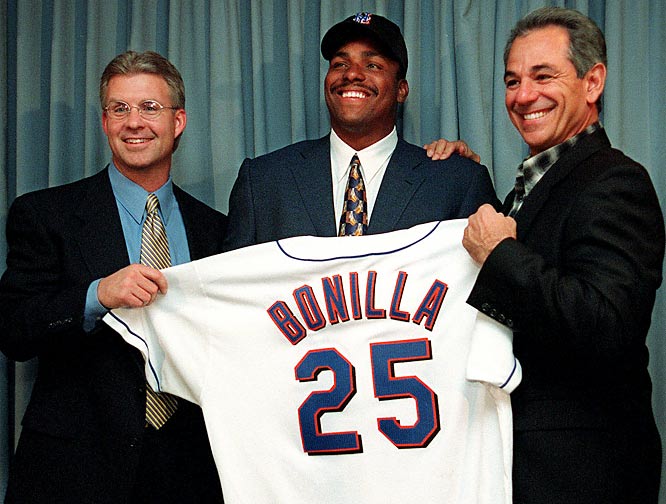
However, I thought it would be interesting to note that he is not, in fact, the highest-paid player in the history of professional baseball, at least in terms of the total value of any single season. As much as he is 'earning' on his current abominable contract, his gains from it pale in comparison to one which is being paid out even now to a player who has been out of the game as a player since 2001.

That 'honor' belongs to Bobby Bonilla.

Bonilla had returned to the Mets in 1999, where his lackluster play (along with 'personality issues') caused him to wear out his welcome. In response to this revelation (whatever), the Mets actually paid him to leave.

Keep in mind that in his previous stint with the Mets in 1992, he had already threatened sportswriter Bob Klapisch with a beatdown, telling him that he would "show him the Bronx". I can only assume that one would not wish to see the Bronx, or at least not the part that Bonilla wants to visit.

Hindsight being what it is...
At the time, they still owed him 5.9 million bucks. In order to get him off their books, they worked out a deal which would defer the remaining money over a 25-year period. They already owed him 500,000 dollars per year, which started in 2004, that would continue over a 25-year period. This was separate from the deferred payments agreed upon for the 5.9 mil contract they were ridding themselves of from the beginning of the 2000 season.

Considering the payments beginning from 2004 of half a million per year, in addition to the 1.1 mil+ payments beginning in 2011 (which will continue to 203-freaking-5), all of which assumes an annual 8% interest rate, the Mets would essentially owe him a total of over 42 million for that one-year contract of 2000. The Mets will be paying Bobby Bo until he turns 73. Celebrity Net Worth has a much better explanation of this whole mess.

The annual interest rate comes into play because Bonilla was being paid from an investment account which the Mets set up for him. In short, what this means is that the Mets actually earned interest on the principal from Day One, from which they paid Bonilla (obviously), but also from which they increased their initial investment. That means (again, reference Celebrity Net Worth's page on this) that they actually came out ahead in this whole mess.

Of course, it also means that they were paying a player who no longer suits up, and hasn't done so for 13 years. And counting.

Convoluted, to say the least. And all to remove the cancer which had invaded their clubhouse. Sadly, no universal health care system can treat a Bonilla infection.

Nowadays, teams often back-load contracts in order to keep their annual budgets lower. That means there will be a number of players (potentially) who will be drawing paychecks long after they've either left the team or retired altogether. It takes a steady mind to keep all of this crap straight.

Gee. When I work, I just get a plain ol' check. Should have been a ballplayer.


Saturday, July 20, 2013

Lexington Legends Update: The Hitters-July 20th, 2013

In the minor leagues, numbers really don't mean a whole lot.

Don't get me wrong; I should say that they don't mean as much as they would in the majors. Down here, it's all about developing talent, not reaping the rewards of the end product. 

With that in mind, there is much to like about this Legends team. 

While it is true that our offense has had its issues, the second half has been a stunning success overall. Not only are the Legends in first place in their division (17-9, 2.0 games ahead of 2nd place Greenville), they currently have the best second half record in all of the South Atlantic League. They've been able to accomplish this largely on the strength of an outstanding pitching staff and well-timed hits. No single hitter on this team has stood out this year, but there are a number of highlights of note. A quick look at some of the hitters:

Michael Antonio, 3B

2013:
86 games, 337 PA, 17 R, 14 2B, 4 HR, 32 RBI, 28 BB, 53 K, .195 BA, .268 OBP

Antonio has, like many of the hitters on this team, had a tough go of it at the plate this year. One of my favorite players to watch, I still see at least one issue with his approach. He has good natural power, but it comes from a sometimes-violent swing which could likely be shortened up a bit without his giving up much power. Until he's able to do that, he's going to strike out quite a lot. However, even with this approach, he's at his best in clutch situations (.246 BA with 2 outs and runners in scoring position). I would still like to see him shorten up a little. Being an aggressive swinger is not, in and of itself, a bad thing. But in his case, it's hurting more than it's helping.

Mark Donato, 1B-DH

2013:
38 games, 156 PA, 13 R, 8 2B, 4 HR, 21 RBI, 9 BB, 26 K, .292 BA, .333 OBP, .764 OPS

I did an interview with Donato near the end of last season in anticipation that he would be with us this year. I expected big things of him, and he has not disappointed. In 38 games with Lexington, he has either driven in or scored (or both) 34 runs, and he's on pace for 30+ doubles and double-digits in homers. He's hit significantly better at home (.339 BA, .938 OPS at home vs. .259 and .641 on the road), and has flagged off a bit in July (.233 BA in 12 games), but I expect this will balance itself out. He handles first base well, as he is quick on his feet, shows ample range to both sides, and is confident in every defensive scenario in which I've seen him, thus far. A full year here in Lexington could bring 20+ homers and at least 90 RBI, numbers which he could potentially meet this year even though he's only been here since the end of May.

Fred Ford, RF

2013:
87 games, 342 PA, 36 R, 13 2B, 4 3B, 9 HR, 32 RBI, 42 BB, 119 K, .207 BA, .681 OPS

Ford started out the year at first base, a position with which he was not nearly as accustomed as right field. He acquitted himself well filling in for an injured Mark Threlkeld, but I feel that his switch to first (along with this being his first year in Class A ball) likely affected his batting a bit. At 6'5”, Ford is always going to have to work hard to control the strike zone. He showed a notable improvement in this regard when in June he cut his strikeouts down to 26 in 22 games, as opposed to the previous month when he was rung up 40 times in 28 games. His BB/K ratio was significantly better in June than in any other month so far, and he posted a monstrous .912 OPS in that month. Ford will post strong power numbers in the future as long as he can make more frequent contact than he is now. Again, I think this will come along with time.

Cam Gallagher, C

2013:
40 games, 156 PA, 10 R, 11 2B, 2 HR, 14 RBI, 12 BB, 12 K, .230 BA, .647 OPS

Gallagher has played in only 40 games thus far, having missed a chunk of time when Asheville righty Shane Broyles plunked him in the arm on April 24th (Cory Hall returned the favor, with 1B Derek Jones being the victim), so he's had to deal with recovering from the resultant fractured forearm. Gallagher has been a prospect of note since he was drafted in the 2nd round in 2011, and he will certainly show above-average power when he hits his peak. Catchers traditionally take longer to develop, but he will definitely be worth the wait. I expect his CS rates to improve in the near future (he's thrown out 29% of basestealers, thus far), while he already handles the staff very well.

Terrance Gore, LF

2013:
86 games, 359 PA, 53 R, 5 2B, 2 3B, 20 RBI, (spoiler alert, T!) 50 SB, 41 BB, 73 K, .226 BA, .342 OBP

Gore is one of the fastest players I've ever seen, at any level. I've timed him at 3.9 or less to first so many times that I've stopped keeping track, and he continues to cover enough territory in the OF that the Legends could almost get away with two outfielders. He plays the field next to CF Bubba Starling, who is a speedster in his own right, and there are plenty of times when they arrive at a fly ball at the same time. It's starting to look like my preseason prediction about Gore will be, at least, pretty darn close (I said I'd expect 100 swipes out of him if he spent the whole year in Lexington). There's more to him than just speed, though; while he is a smallish player, he is powerfully built. When his bat catches up, he should be the kind of hitter who produces double-digits in doubles and triples, with 50+ steals in the majors. It all depends on that bat, however.

Raul Mondesi, SS

2013:
83 games, 357 PA, 38 R, 11 2B, 5 3B, 5 HR, 38 RBI, 16 SB, .261 BA, .680 OPS

Mondesi is batting .261, is helping a great deal to carry the offense, has a cannon for an arm and has invaded the right side of the infield as a shortstop. And he turns 18 on the 27th of this month. There's nothing I need to add to that. He's pretty good.

Bubba Starling, CF

2013:
85 games, 343 PA, 41 R, 14 2B, 8 HR, 41 RBI, 12 SB, 36 BB, 89 K, .217 BA, .656 OPS

By now, most Legends fans know that Bubba started the year having great difficulty picking up the ball while at the plate. There's a 100-point difference in his BA between day and night games (.289 in day games, .189 at night), and that was a big red flag from the get-go. He has since had LASIK surgery to correct that. There has been concern in the past from fans who felt that he was too raw to ever reach his full potential in baseball, and that he should have gone the football route. Those fans were premature in their assessment. Starling will, at the very least, develop into a plus defender with above-average power and speed, and even if that's all he gives the Royals then they should be more than happy with it. Fans should also keep in mind that he doesn't turn 21 until August 3rd, so I think taking a 'wait and see' approach is the best way to go, here. He has already made strides in the past month, though he does continue to strike out a lot more than you'd like to see. He may always record a lot of Ks, but he'll offset that with extra-base hits in bunches. Worth it, I'd say.